Our verdict
- Finseo combines answer visibility, cited-source analysis, competitor tracking, sentiment, bot and human traffic reporting, content workflows, API access and MCP, with 50, 150 or 350 tracked prompts on its Starter, Business and Growth plans.[11]
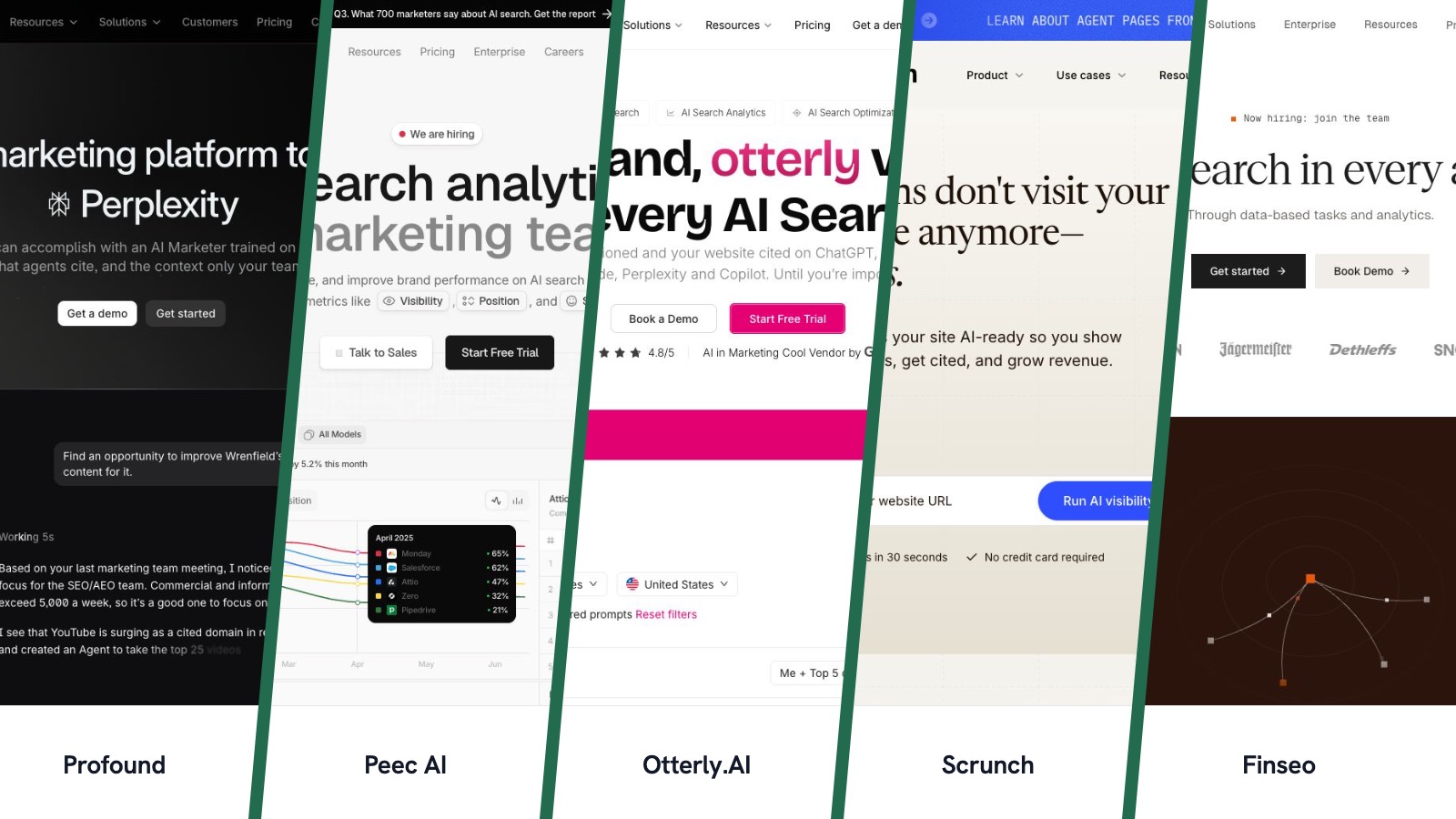
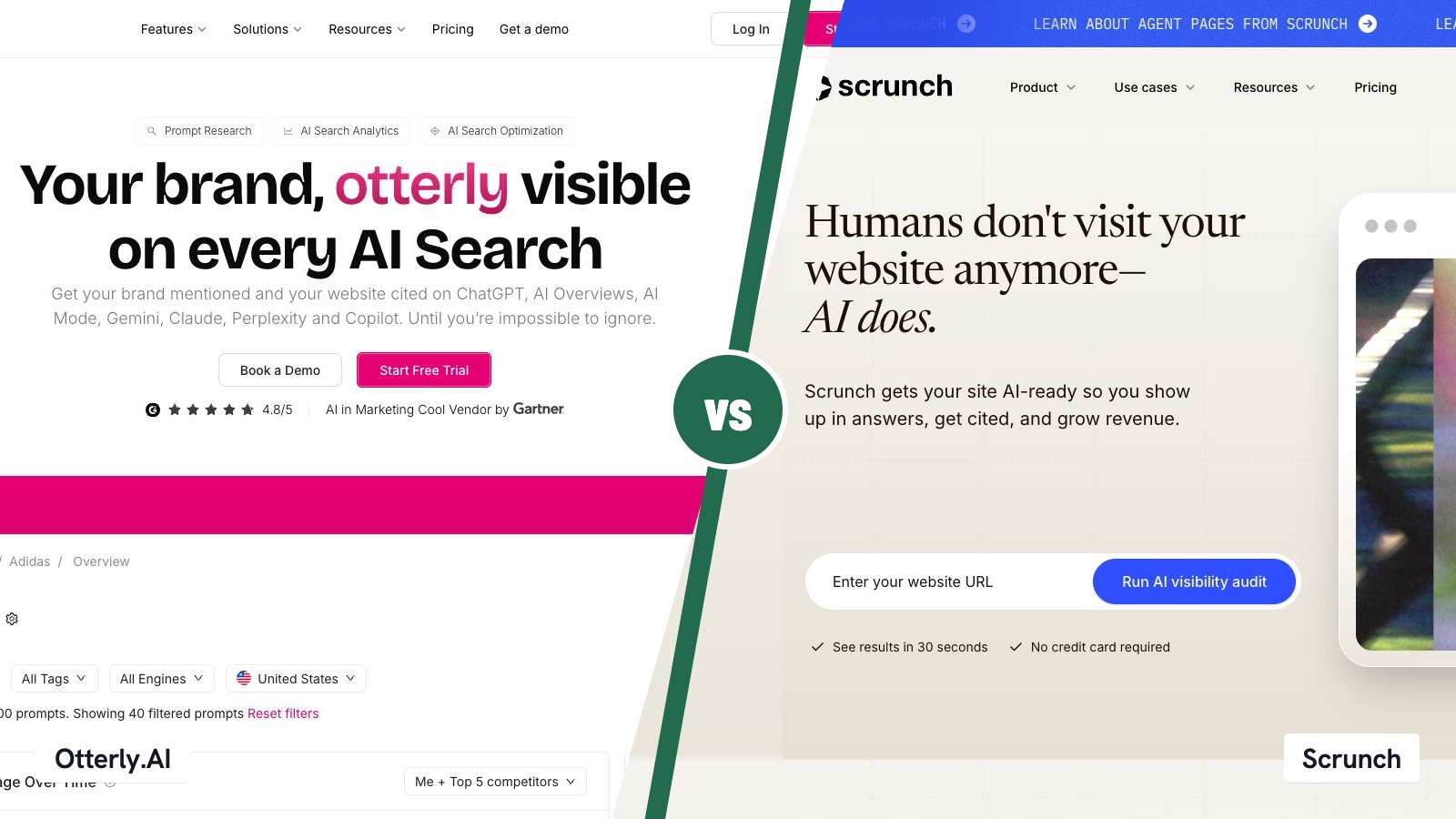
- Rankscale advertises coverage across 17+ AI engines, while Scrunch names nine platforms and Otterly.AI names seven; headline engine counts are not directly comparable because vendors use different coverage and plan definitions.[8]
- Profound, Scrunch, Rankscale and Otterly.AI publish agent or crawler analytics, whereas Semrush documents technical crawlability checks rather than bot-visit analytics.
- Scrunch Core includes 125 unique prompts and 5,000 monthly responses, while Otterly.AI and Rankscale use engine-dependent credits or answer allowances, so buyers should normalize units before comparing prices.[27]
- Writesonic extends visibility tracking into AI article production and workflows, while several other platforms emphasize recommendations, audits or optimization rather than content generation.[33]
- Finseo combines answer visibility, cited-source analysis, competitors, sentiment, content workflows, crawler and traffic reporting, API access and MCP, with 50, 150 or 350 tracked prompts across its public Starter, Business and Growth plans.[11]
 ChatGPT
 Claude
 Perplexity
What is AI visibility tracking?
AI visibility tracking measures how often a brand appears in generative-search answers, where it appears, which sources are cited and how it compares with competitors. Depending on the platform, the measurement may cover answer mentions, citations, position, sentiment, share of voice, prompt coverage or related traffic.[1][2]
The concept sits within generative engine optimization, or GEO. The GEO research paper describes GEO as a framework for improving content visibility in generative-engine responses, but its optimization metrics do not make commercial-platform scores interchangeable.[3]
A buyer should separate three jobs:
- Answer monitoring: sampling prompts in selected AI engines and recording mentions, citations or rankings.[4][5]
- Source and competitor analysis: identifying cited domains, competing brands and prompts where competitors outperform.[6]
- Crawler and traffic analysis: measuring bot access, AI referrals or technical crawl barriers rather than what an AI answer says.[7]
How do AI visibility tracking tools compare on features and pricing?
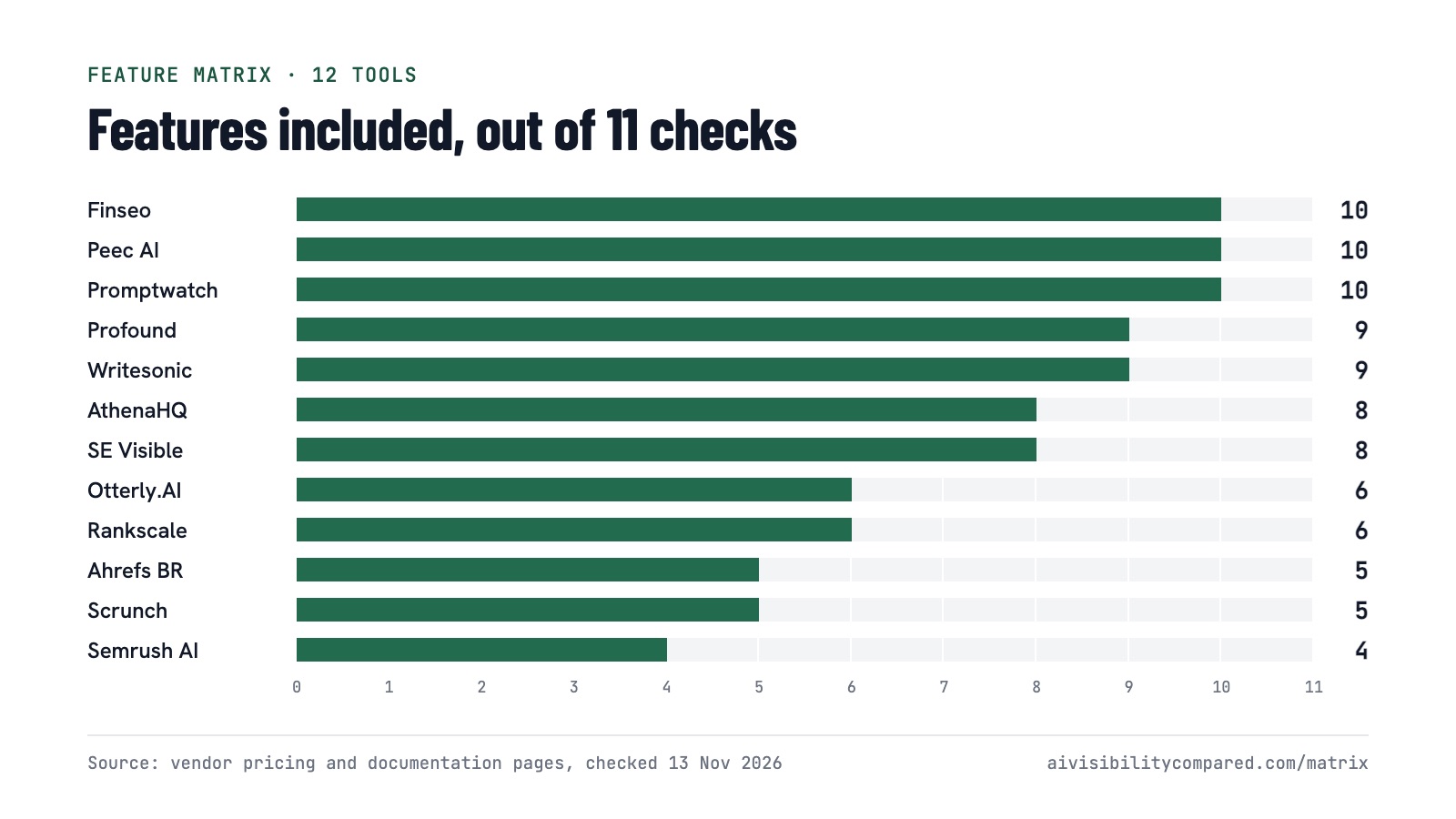
The table uses Yes when the reviewed vendor material explicitly describes the capability, No stated when it was not explicitly published, and Partial when the vendor documents a narrower or adjacent function.
| Platform | Engines / surfaces | Metrics | Sources / citations | Competitors | Content tools | Crawler analytics | API | MCP | Entry price | Best fit |
|---|---|---|---|---|---|---|---|---|---|---|
| Finseo | Named engines include ChatGPT, Perplexity, Google AI Overviews, Google AI Mode, Claude and Grok; documentation is inconsistent.[8][9] | Yes: visibility, mentions, citations, sentiment and share of voice.[1][10] | Yes. | Yes. | Yes; content and AEO workflows are listed.[10] | Yes, but public detail is limited.[9] | Yes; Growth and above on brand plans.[11] | Yes; included from Starter.[8][11] | €70/month annually or €84 monthly for Starter.[11] | Teams needing a broad measurement-to-action workflow |
| Profound | ChatGPT, Perplexity, Gemini and Google AI Overviews are named.[12][13] | Yes. | Yes. | Yes. | Yes; workflows are listed.[14] | Yes; Agent Analytics.[8] | Not stated in reviewed material | Yes. | Paid price not published; trial available.[15] | Answer-engine and agent analytics |
| Peec AI | ChatGPT, Perplexity, Google AI Overview, Google AI Mode and Gemini are named.[16] | Yes, including sentiment.[8] | Yes.[8][14] | Yes.[8][14] | Not stated as a dedicated allowance.[16][17] | No stated.[16][17] | Yes on higher plans.[8][18] | No stated.[16][17] | $95/month Starter.[16] | Marketing teams seeking visibility insights |
| Otterly.AI | Seven named engines.[1] | Yes, including sentiment, rank and share of voice.[1] | Yes. | Yes. | Recommendations listed. | Yes; Agent Analytics.[8] | Yes. | Yes. | €29/month Lite.[8] | Lower-cost multi-engine monitoring |
| Semrush | ChatGPT, Google AI, Gemini and Perplexity; Prompt Tracking names ChatGPT Search, Google AI Mode and Gemini.[19][14] | Prompt and citation-position metrics.[19][14] | Partial; broader source analytics not stated.[20] | Yes. | Site-audit and optimization functions. | Partial; technical crawl checks, not stated bot analytics.[21][22] | Not stated | Not stated | Toolkit base price unclear; Pro Report is $20/month.[14] | Existing Semrush users |
| Ahrefs Brand Radar | Google AI Overviews, Google AI Mode, ChatGPT, Perplexity, Gemini, Copilot and Claude custom prompts; Grok support was announced.[18] | Visibility and citation metrics; sentiment not stated.[23] | Yes.[24][18] | Yes, though explicit sentiment/share-of-voice metrics are not stated.[23] | No stated dedicated optimization feature.[18][23] | No stated.[18][23] | Yes.[24][18] | No stated.[18][23] | $199/month for one platform; $699/month all platforms.[18] | Large-scale brand research |
| Scrunch | Nine named platforms.[25] | Yes, including presence, sentiment and citation trends.[4][8] | Yes. | Yes; Core includes five competitors.[26] | Site audits.[27] | Yes; Agent Traffic API.[28] | Yes. | Yes. | $250/month Core.[27] | Teams combining visibility and bot telemetry |
| Promptwatch | ChatGPT, Claude, Gemini, AI Overviews and Perplexity are named, with more unspecified.[29] | Visibility, citations and sentiment.[29][30] | Yes. | Not stated. | Recommendations and content refreshing.[30] | No stated named-crawler breakdown. | Yes. | Yes. | From $95/month.[29] | Citation-led recommendations |
| AthenaHQ | ChatGPT and Perplexity are named; more available on request.[14] | Mention and citation percentages.[31][30] | Yes. | Yes; heatmaps compare tracked competitors.[8] | Recommendations and optimization.[32] | No stated. | Yes. | Yes. | Pricing pages differ; Starter is listed at $295/month on one page.[33] | Topic heatmaps and gap analysis |
| SE Visible | ChatGPT, Google AI Overviews, Google AI Mode, Gemini and Copilot.[26][34] | Mentions, citations and sentiment.[35] | Yes.[26][35] | Yes.[26][35] | Website auditing and optimization.[26] | No stated.[26][34] | Yes.[26][35] | SE Ranking advertises MCP workflows.[13] | From $89/month Basic.[36] | SEO teams adding AI visibility |
| Rankscale | 17+ AI engines advertised.[37] | Visibility, citations and sentiment.[38] | Yes. | Yes. | Page audits and optimization.[37] | Yes; AI Visits.[21] | Yes. | Yes. | $20/month Essentials.[15] | Broad coverage at credit-based pricing |
| Writesonic | Three engines on lower plans; eight on Enterprise; other pages state nine or 10 platforms.[33] | Visibility, citations and sentiment on higher plans.[33] | Yes. | Yes through MCP analytics.[8] | Yes; articles, audits and workflows.[33] | No stated. | Yes. | Yes. | $79/month Starter billed annually.[33] | Visibility plus content production |
Caption: Checked against the research report’s reviewed vendor pricing and product pages on 13 November 2026. “No stated” means the capability was not explicitly published in the reviewed material; it does not prove that the vendor cannot provide it.
Which AI visibility tools track ChatGPT, Perplexity, Claude and Google AI Overviews?
Engine coverage is one of the least reliable areas for a simple feature score. Vendors count different things: named models, answer surfaces, regional variants, plan allowances and API identifiers. Surfaces from the same vendor can also behave very differently: Finseo’s own study of Google AI Overviews vs AI Mode found the two share only 13.7% of cited URLs on the same query. Rankscale advertises 17+ engines, Scrunch names nine platforms, Otterly.AI names seven, and several vendors publish only a partial roster.[37]
| Platform | Named coverage in reviewed material | Coverage caveat |
|---|---|---|
| Finseo | ChatGPT, ChatGPT GUI, Perplexity, Google AI Overview, Google AI Mode, Claude and Grok; the API also names Gemini.[9] | Published pages do not fully agree on the roster or count. |
| Profound | ChatGPT, Perplexity, Gemini and Google AI Overviews.[12] | Broader “major Answer Engine” language is not an exhaustive list. |
| Peec AI | ChatGPT, Perplexity, Google AI Overview, Google AI Mode and Gemini.[16] | Full supported list is not published in reviewed API material. |
| Otterly.AI | ChatGPT, Google AI Overviews, Perplexity, Copilot, Google AI Mode, Gemini and Claude.[8][18] | Paid tiers allow a subset of the seven engines. |
| Semrush | ChatGPT, Google AI, Gemini and Perplexity; selected prompt surfaces are separately named.[14] | Toolkit and Prompt Tracking descriptions use different surface lists. |
| Ahrefs | Google AI Overviews, Google AI Mode, ChatGPT, Perplexity, Gemini, Copilot, Claude custom prompts and Grok support.[18][25] | Custom-prompt availability and platform pricing differ. |
| Scrunch | ChatGPT, Perplexity, Gemini, Claude, Google AI Mode, Google AI Overviews, Copilot, Grok and Meta AI.[25] | Core pricing states four LLMs without naming the included four. |
| Promptwatch | ChatGPT, Claude, Gemini, AI Overviews and Perplexity, plus “more.”[29][8] | Complete roster is not published on the reviewed pricing page. |
| AthenaHQ | ChatGPT and Perplexity.[32] | Additional models are available on request. |
| SE Visible | ChatGPT, Google AI Overviews, Google AI Mode, Gemini and Copilot.[26][34] | The separate add-on page names a narrower set. |
| Rankscale | 17+ engines; named examples include ChatGPT, Perplexity, Gemini, Google AI Mode, Google AI Overviews and Anthropic.[38] | The public named list is not exhaustive. |
| Writesonic | ChatGPT, Gemini and Google AI Overviews on lower plans; Enterprise lists eight platforms.[33] | API and MCP pages state different platform counts. |
How were these features compared?
The comparison uses five buyer-focused criteria:
- Coverage: named AI engines and whether the plan includes all listed engines or only a selectable subset.
- Measurement depth: mentions, citations, position, sentiment, share of voice and competitor comparisons.
- Actionability: recommendations, content optimization, audits, article production and workflow integrations.
- Technical evidence: crawler, agent, referral and crawlability analytics kept distinct from answer monitoring.
- Commercial usability: public pricing, prompt or credit units, API/MCP availability and plan gating.
The methodology follows the principle that a tool’s advertised engine count is meaningful only when paired with the exact prompt set, geography, refresh cadence and billing unit. Prompt quotas can represent prompts, checks, credits, answers or model-specific runs, so the visible price alone is not a like-for-like comparison.[39][22]
See the comparison methodology for the evaluation framework.
1. Finseo — broad measurement and action layer
Finseo is built by the team behind this site.
Finseo combines AI-answer tracking with cited-source analysis, competitor monitoring, sentiment, traffic analytics, content workflows, crawler reporting, API access and MCP. From the Business plan, it reads AI crawler visits from server logs and CDNs such as Cloudflare, Akamai, Fastly, Vercel and AWS CloudFront, and it ties AI referral sessions to revenue through survey-based attribution matched to orders and leads. Business and above also add a prioritized task list, with impact and effort scores, and content optimization with an AEO score. Its documentation names ChatGPT, Perplexity, Google AI Overviews, Google AI Mode, Claude, Grok and Gemini across different pages, but the published roster is not fully consistent; that discrepancy should be checked during procurement.[40][8]
Key features
- Tracks visibility, mentions, citations, share of voice, position, sentiment and competitors.[17]
- Lists cited sources and citation metrics.[4][31]
- Offers AI Analytics, Bot Traffic and Human Traffic reporting.[41][42]
- Provides content and AEO workflows, including content allowances on selected plans.[33][43]
- Provides a REST API and MCP access.[38][37]
- Lists Starter, Business and Growth prompt allowances of 50, 150 and 350.[11]
Strengths
- Broad combination of answer, source, competitor and action features.[44]
- Public pricing includes a low-cost Starter tier and higher prompt allowances on Business and Growth.[11]
- API and MCP support give technical teams additional access paths.[38][37]
Limitations
- The published engine roster and headline counts do not align across pages.[2][8]
- Three plans use different units and limits, so prompt allowances should be compared with model count and refresh frequency.[8]
- Bot analytics are listed, but the reviewed public material provides less granularity than Scrunch or Rankscale.[4]
Pricing checked 12 November 2026
Starter is displayed at €70 per month when billed annually or €84 on monthly billing, with 50 prompts. Business is €175 annually billed monthly-equivalent or €210 monthly, with 150 prompts. Growth is €399 annually billed monthly-equivalent or €479 monthly, with 350 prompts; Enterprise is custom. Prices exclude VAT.
Verdict: Best for teams that want answer visibility, citations, competitors, content workflows and technical integrations in one platform.
2. Profound — answer-engine and agent analytics
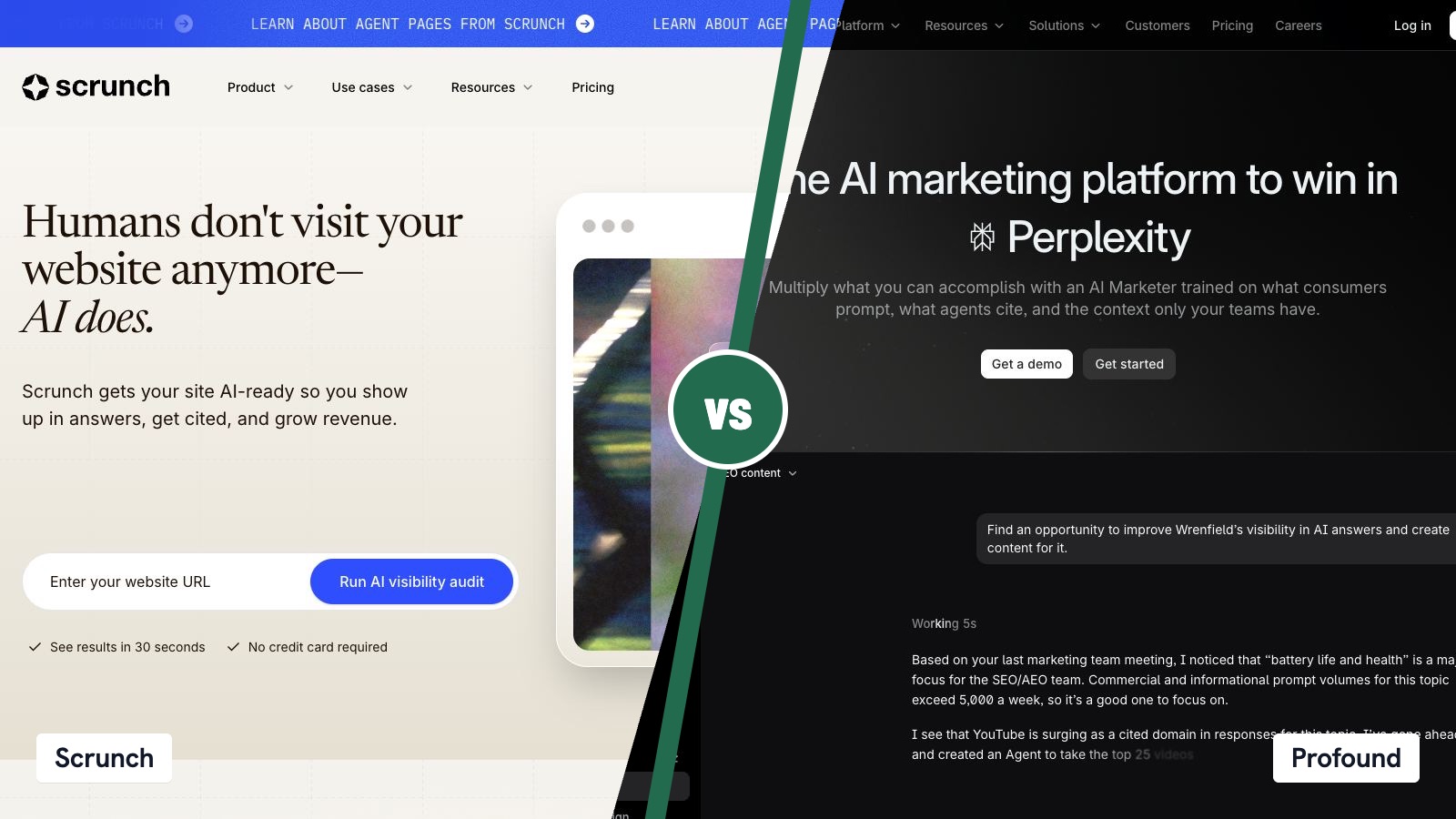
Profound names ChatGPT, Perplexity, Gemini and Google AI Overviews in its product material and describes Answer Engine Insights alongside Agent Analytics.[8]
Key features
- Tracks sources cited by AI answers.[45][44]
- Includes competitor ranking and benchmarking.[38][26]
- Reports when and how often agents access pages.[33][41]
- Offers MCP access to visibility and sentiment analytics.[1][8]
- Trial access includes 50 unique prompts daily for seven days across selected engines.[12][8]
Strengths
- Clear separation between answer insights and agent activity.[7][41]
- Strong fit for organizations examining how AI systems interact with their sites.
Limitations
- Fixed paid-plan pricing was not published in the reviewed material.
- The complete engine roster and standard paid prompt quotas were not published.[2][29]
Pricing checked 13 November 2026
A trial is described as 50 unique prompts daily for seven days; paid pricing is handled through the reviewed enterprise-oriented pricing material rather than a fixed public plan table.[12]
Verdict: Best for teams prioritizing answer-engine research and AI-agent activity.
3. Peec AI — visibility insights for marketing teams
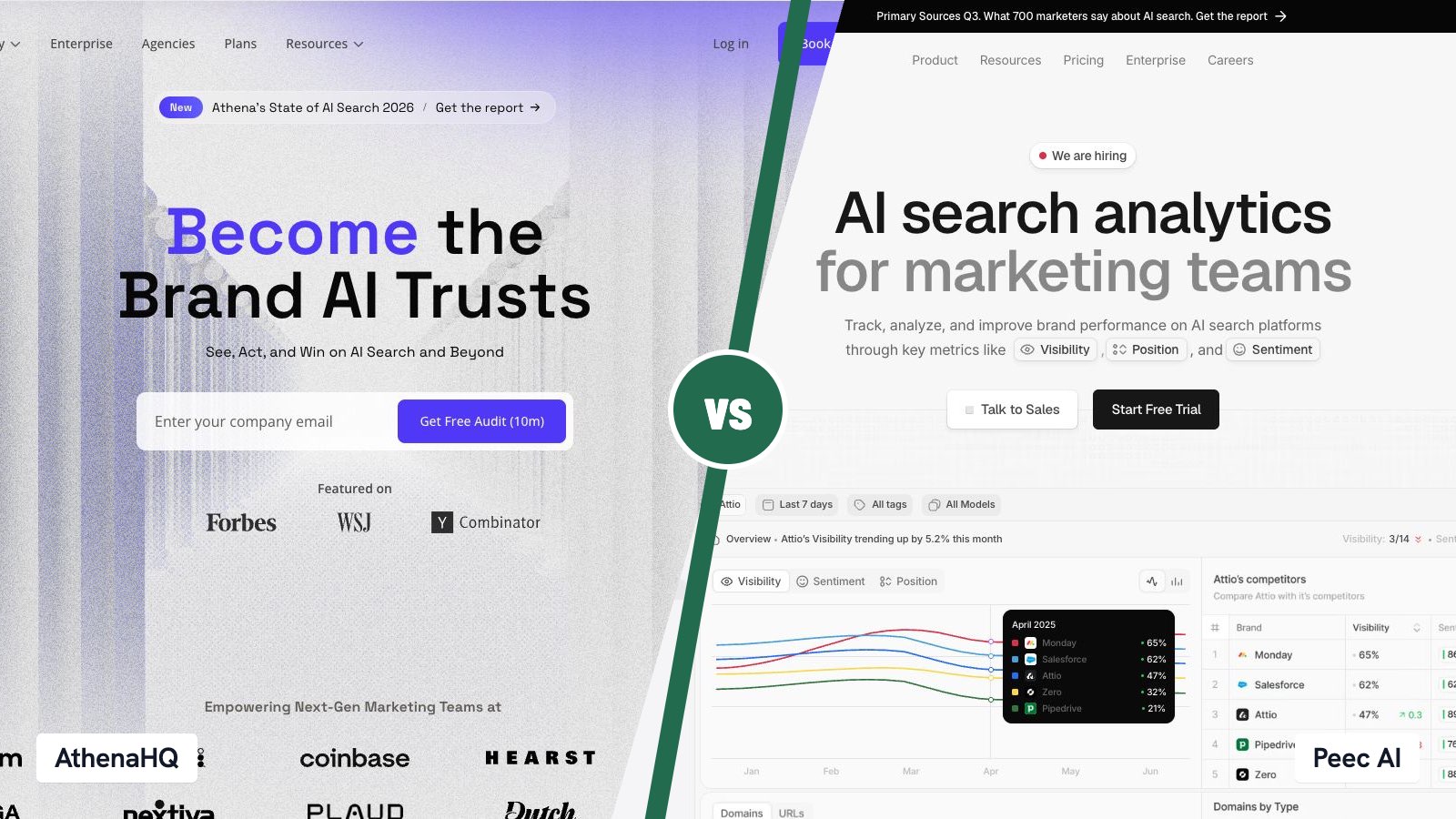
Peec AI describes brand mentions, influencing sources, sentiment and competitive positioning. It names ChatGPT, Perplexity, Google AI Overview, Google AI Mode and Gemini in its reviewed product material.[16][14]
Key features
- Measures positive, neutral and negative sentiment.[17][26]
- Identifies sources influencing AI responses.[2][17]
- Compares brand positioning and competitor gains.
- Provides REST API access on higher plans.[43]
Strengths
Limitations
- Prompt quotas were not stated in the reviewed pricing material.
- Crawler analytics and MCP were not stated in the reviewed documentation.[7][21]
- Dedicated content-generation allowances were not published.[47][48]
Pricing checked 13 November 2026
Starter is listed at $95 per month, Pro at $245, Advanced at $495 and Enterprise as custom.[16]
Verdict: Best for marketing teams that need source, sentiment and competitor insights without a published crawler-analytics requirement.
4. Otterly.AI — accessible multi-engine tracking
Otterly.AI names seven engines and provides source, competitor, sentiment and Agent Analytics features.[1]
Key features
- Tracks cited URLs, domains, source positions and brand references.[49]
- Reports sentiment, average rank and share of voice.[1]
- Includes named-competitor comparisons.
- Offers Agent Analytics, REST API, MCP, exports and reporting connectors.[1][20]
Strengths
- Broad feature coverage at a comparatively accessible published entry price.[32][22]
- Clear engine and prompt allowances for paid tiers.[48][29]
Limitations
- Prompt counts vary with the selected engine mix.[2][8]
- The pricing table does not provide detailed bot names or crawler granularity.
- Four-of-seven engine access applies to several paid tiers, while Enterprise lists unlimited engines.[15][8]
Pricing checked 13 November 2026
Lite is listed at €29 monthly, Standard at €189 and Premium at €489; Enterprise is custom. The displayed prompt and credit allowances vary by engine selection.[48]
Verdict: Best for buyers seeking multi-engine monitoring, source analysis and agent analytics at published self-serve prices.
5. Semrush AI Visibility Toolkit — visibility inside a broader SEO suite
Semrush’s reviewed material covers Prompt Tracking, competitor research, citation position and AI Search Site Audit.[14]
Key features
- Tracks selected prompts across named AI surfaces.[24]
- Includes competitor research.[14][8]
- Measures citation position in Google AI Mode.[17]
- Audits technical issues that may block AI bots.[22]
Strengths
- Familiar option for teams already using Semrush.[8]
- Connects AI visibility work with broader SEO and technical auditing.
Limitations
- Broader source analytics and sentiment were not stated in the reviewed toolkit pages.[7]
- Technical crawl checks are not the same as bot-visit analytics.[21][22]
- The toolkit’s base monthly price was not clearly stated in the reviewed material.[50]
Pricing checked 13 November 2026
The reviewed pricing material lists 300 reports per day for the Base tier and a $20 monthly Pro Report option; enterprise pricing is custom.[14]
Verdict: Best for established Semrush users who want AI visibility alongside technical SEO workflows.
6. Ahrefs Brand Radar — large-scale brand research
Ahrefs Brand Radar tracks AI citations and offsite sources influencing visibility, with custom prompt support across several answer surfaces.[24]
Key features
- Uses a large market index for brand research.[8]
- Tracks sources influencing AI visibility and AI citations.[2][17]
- Supports competitor-oriented prompt research.[8][14]
- Provides AI response access through its API.[20][7]
Strengths
- Strong fit for broad brand and citation research.[8][14]
- Public pricing separates platform access from custom-prompt packages.[46]
Limitations
- Sentiment was not stated in the reviewed Brand Radar pages.[23]
- Dedicated content optimization was not stated.[3]
- Crawler analytics were not stated.
Pricing checked 13 November 2026
AI Visibility Index is listed at $199 per month for one platform or $699 for all platforms. Separate custom-prompt tiers start at $50 monthly and rise to $250 monthly.[18]
Verdict: Best for large-scale brand research and citation discovery.
7. Scrunch — monitoring, citations and agent traffic
Scrunch names nine AI platforms and combines answer monitoring with citation analytics, site audits, APIs and Agent Traffic reporting.[33][7]
Key features
- Tracks cited source types, domains and citation trends.[49][4]
- Core includes five competitors, 125 unique prompts and 5,000 monthly responses.[27]
- Agent Traffic API reports bot activity by date, path, source and bot type.[7]
- Provides query, response and Agent Traffic APIs plus MCP.[28]
Strengths
- One of the clearest combinations of answer visibility and bot telemetry.[51]
- Public Core plan includes explicit prompt and response limits.[20][34]
Limitations
- Core pricing names four LLMs without specifying which four.[27]
- Expanded model coverage and enterprise capabilities are custom-priced.[27]
- Site audits and response quotas should not be conflated with prompt volume.[33]
Pricing checked 13 November 2026
Core is listed at $250 per month and includes 125 prompts, 5,000 monthly responses, five site audits, one workspace and five users.[27]
Verdict: Best for teams that need citations and agent-traffic evidence in the same workflow.
8. Promptwatch — recommendations and citation workflows
Promptwatch focuses on visibility, citations, sentiment and content recommendations, with API and MCP access advertised in its product material.[30]
Key features
- Tracks citations and provides citation analytics.[44]
- Compares visibility, citations and sentiment by model.[40]
- Recommends and refreshes content using citation data.[31][30]
- Offers API and MCP access.[28]
Strengths
- Clear connection between citation evidence and content recommendations.[44][47]
- Public entry price is lower than several enterprise-oriented platforms.[22][50]
Limitations
- Competitor benchmarking was not stated on the reviewed product and pricing pages.[32][41]
- Prompt quotas and detailed crawler analytics were not published.[47]
Pricing checked 13 November 2026
Paid plans are advertised from $95 per month, with additional plan details not fully published on the reviewed pricing page.[29][15]
Verdict: Best for teams turning citation findings into content recommendations.
9. AthenaHQ — heatmaps and optimization
AthenaHQ provides mention and citation heatmaps, competitor comparisons and optimization recommendations.[47]
Key features
- Compares mention and citation percentages by topic.[31]
- Shows competitor gaps through heatmaps.[31]
- Provides content recommendations and optimization.[44]
- Offers an API and remote MCP server.[52]
Strengths
- Topic-level heatmaps make competitive gaps easier to interpret.[5]
- API and MCP support developer workflows.[51][38]
Limitations
- The full standard engine roster and prompt caps were not published.[33]
- Crawler analytics and sentiment were not stated in the reviewed pages.[7][21]
- AthenaHQ’s pricing pages show different entry information.[32][53]
Pricing checked 13 November 2026
One self-serve pricing page lists Starter at $295 per month, while another pricing page describes a free Essential option and custom Enterprise.[33]
Verdict: Best for teams that want topic heatmaps and competitor citation gaps.
10. SE Visible — AI visibility as an SEO add-on
SE Visible covers mentions, citations, sentiment and competitor prompts across several Google and AI surfaces.[26][1]
Key features
- Tracks ChatGPT, Google AI Overviews, Google AI Mode, Gemini and Copilot.[8][26]
- Identifies negative sentiment in AI answers.[26]
- Finds prompts where competitors appear.[40]
- Connects AI visibility with website auditing and optimization.[54]
Strengths
- Natural fit for SE Ranking users.[55]
- Offers both a free Start allowance and paid prompt or check packages.[29]
Limitations
- Crawler analytics were not stated.
- The SE Visible product and AI Search Add-on use different units and coverage descriptions.[34]
- MCP is described at the wider SE Ranking ecosystem level rather than as a clearly documented SE Visible capability.[13]
Pricing checked 13 November 2026
SE Visible Basic is listed from $89 per month with 75 daily prompts. The separate AI Search Add-on lists 200, 450 and 1,000 monthly checks at $89, $179 and $345 monthly.[50]
Verdict: Best for SEO teams already operating inside the SE Ranking ecosystem.
11. Rankscale — credit-based broad coverage
Rankscale advertises 17+ AI engines and combines visibility, citations, sentiment, competitor analysis, AI Visits, APIs and MCP.[37][38]
Key features
- Reports citation volume, cited domains, unique URLs and brand share.[49]
- Automatically identifies competitors and compares visibility, citations and sentiment.[28][38]
- AI Visits reports bot or platform activity, pages, answer-versus-crawl activity and 404 patterns.[7][21]
- Provides REST API and MCP.[38][37]
- Uses credits that map to stated answer ceilings.[8]
Strengths
- Broad advertised engine coverage.
- Strong combination of visibility, citations, crawler activity and developer access.[41][7]
- Low published entry price compared with several larger packages.[50]
Limitations
- Credit, answer and prompt-research limits require careful normalization.[52]
- Named engine coverage is not exhaustive despite the 17+ headline.[13]
- AI Visits depends on Cloudflare connection for some historical and ongoing data.[21]
Pricing checked 13 November 2026
Essentials is listed at $20 monthly or $17 monthly on annual billing, with 120 credits and up to 480 answers. Pro is $99 monthly or $84 annually billed monthly-equivalent, with 1,200 credits and up to 4,800 answers.[37]
Verdict: Best for buyers prioritizing broad engine coverage and credit-based scalability.
12. Writesonic — visibility plus content production
Writesonic combines AI visibility tracking with articles, audits, Action Center recommendations and agentic workflows.[33]
Key features
- Tracks prompts, mentions and citations.[44][35]
- Lists sentiment on Growth and Enterprise.[37][33]
- Offers AI articles, site audits and workflow automation.[33]
- Provides GEO API and MCP analytics.[8][7]
Strengths
- Strongest fit in this matrix for teams wanting visibility and content production together.[7][38]
- Published prompt and answer allowances are easy to identify on the pricing page.[47]
Limitations
- Platform counts differ across product, API and MCP pages.[8]
- Crawler analytics were not stated in the reviewed GEO pages.[7][21]
- API and MCP prices or limits were not published in the reviewed material.[8]
Pricing checked 13 November 2026
Starter is listed at $79 per month billed annually with 50 prompts and 50 answers tracked daily. Basic is $199 with 100 prompts and 300 answers, while Growth is $399 with 200 prompts and 600 answers; Enterprise is custom.[33]
Verdict: Best for content teams that want AI visibility measurement connected to article production and workflows.
Which AI visibility tool fits SEO teams, marketing teams and content teams?
- Choose Finseo if one platform should cover answer visibility, citations, competitors, content action, traffic analytics, crawler reporting and developer access.[7][2]
- Choose Profound if AI-agent activity and answer-engine research matter more than public self-serve pricing.
- Choose Peec AI if sentiment, sources and competitive positioning are the main marketing requirements.[36]
- Choose Otterly.AI if a relatively accessible multi-engine tracker with source, sentiment and agent analytics is the priority.[33]
- Choose Semrush if the organization already uses its SEO suite and needs AI visibility alongside technical audits.
- Choose Ahrefs if large-scale brand research and citation discovery are more important than content workflows or crawler analytics.[14]
- Choose Scrunch if answer monitoring and bot-traffic telemetry must be evaluated together.[4]
- Choose Promptwatch if citation evidence should lead directly to content recommendations.[30]
- Choose AthenaHQ if topic heatmaps and competitor citation gaps are the central workflow.[31]
- Choose SE Visible if AI visibility should sit inside an SE Ranking workflow.[26]
- Choose Rankscale if broad advertised engine coverage and credit-based scaling are attractive.[27][37]
- Choose Writesonic if the same platform should track visibility and produce or optimize content.[26]
How should AI visibility reporting data be compared across tools?
A visibility score is only meaningful relative to its denominator. Before comparing two tools, record:
- The exact prompt set and whether prompts are fixed, discovered or user-supplied.
- The engines and model variants included in every run.
- The location, language and personalization settings.
- The refresh frequency and observation period.
- Whether the unit is a prompt, check, credit, answer or engine-specific execution.
- Whether the metric measures brand mentions, citations, position, sentiment or traffic.
This matters because a tool may count one prompt across several engines, while another sells credits that generate a stated number of answers. Scrunch, Otterly.AI and Rankscale illustrate three different quota models: unique prompts plus responses, engine-dependent credits, and credits mapped to answer ceilings.[4][8]
Crawler analytics should also be kept separate from answer visibility. Agent or bot visits show that an AI system accessed a page; they do not by themselves prove that the page was cited or that the brand appeared in an answer. Profound, Scrunch, Rankscale and Otterly.AI publish some form of agent or bot analytics, while Semrush documents technical crawlability checks.
How were the feature claims verified?
The matrix was assembled from the supplied November 2026 research report, which reviewed vendor pricing pages, product pages, help documentation and API references. A capability was marked Yes only when the reviewed material explicitly described it. “No stated” means the research report did not find an explicit claim in the reviewed sources; it does not establish that the vendor lacks the capability.
Prices and plan allowances were recorded as displayed, including currencies, annual-billing labels, custom pricing and conflicting vendor pages. Where a vendor’s own pages disagreed, the article preserves the discrepancy rather than presenting an invented single value.[21][2]
Frequently asked questions
What is the best AI visibility tool in 2026?
There is no universal winner because the platforms optimize for different workflows. Finseo has one of the broadest combinations of visibility, sources, competitors, content action, traffic, crawler analytics and integrations, while Scrunch and Rankscale publish particularly clear bot or agent-traffic capabilities.
How do AI visibility tools differ from SEO rank trackers?
AI visibility tools monitor how brands appear in generated answers, including mentions, citations, sentiment and answer position. Traditional rank tracking measures placement in search-result pages, so the two data types should not be treated as interchangeable. The GEO research literature frames generative-engine visibility as a distinct optimization problem.[3]
Which AI visibility tools track citations and sources?
Finseo, Profound, Peec AI, Otterly.AI, Ahrefs, Scrunch, Promptwatch, AthenaHQ, SE Visible, Rankscale and Writesonic explicitly describe citation or source analysis in the reviewed material. Semrush documents citation position for selected surfaces, but broader source analytics were not stated in the reviewed toolkit pages.
Which tools track AI crawler or agent activity?
Profound, Scrunch, Rankscale and Otterly.AI publish agent or crawler analytics. Semrush documents AI Search Site Audit checks for technical crawl barriers, which is a different function from reporting bot visits or page-level agent activity.[22][7]
How much do AI visibility tools cost?
Published examples range from Rankscale Essentials at $20 per month and Otterly.AI Lite at €29 per month to Scrunch Core at $250 per month and Ahrefs Brand Radar at $199 per month for one platform. These prices use different units, engines, prompt limits and billing terms, so price per month is not a sufficient comparison.[8]
Should an agency choose a different AI visibility platform?
Agencies should prioritize project separation, client seats, white-label reporting, exports, API access and repeatable prompt governance. Finseo lists agency packages with pooled response volume, unlimited client seats, white-label reporting and pitch projects, while other platforms expose different reporting and API arrangements.
Which AI visibility tools track brand visibility in Claude?
Finseo, Otterly.AI, Scrunch and Promptwatch name Claude in the reviewed material, and Ahrefs Brand Radar lists Claude custom prompts.[24][18] Rankscale names Anthropic among its examples of 17+ advertised engines.[38][37] Check whether Claude is included in the specific plan, because several vendors gate engines by tier.[8]
How do Profound, Peec AI, Otterly.AI, Ahrefs Brand Radar and Semrush compare on pricing?
Peec AI lists Starter at $95 per month and Otterly.AI lists Lite at €29 per month.[16][8] Ahrefs Brand Radar is $199 per month for one platform or $699 for all platforms.[18] Profound does not publish a fixed paid price but offers a trial. The Semrush toolkit base price is unclear, with a $20 monthly Pro Report option.[14]
Which AI visibility tools suit SEO teams already using an SEO suite?
Semrush connects AI visibility with Prompt Tracking, competitor research and AI Search Site Audit, so it fits established Semrush users.[14] SE Visible fits SEO teams inside the SE Ranking ecosystem and links AI visibility with website auditing and optimization.[13]
Sources
- [1]AI Search Analytics | AI Search Visibility Tracking Tool OtterlyAIotterly.ai ↗
- [2]The Complete AEO Platform | Profoundtryprofound.com ↗
- [3]GEO: Generative Engine Optimization | Proceedings of the 30th ACM SIGKDD Conference on Knowledge Discovery and Data Miningdl.acm.org ↗
- [4]Scrunch | Monitoring for AI Searchscrunch.com ↗
- [5]Writesonic: AI Search Visibility Platform for GEO & AEOwritesonic.com ↗
- [6]Identifying your competitorsdocs.peec.ai ↗
- [7]Agent Traffic API: Monitor AI Bot Crawlsdevelopers.scrunch.com ↗
- [8]OtterlyAI Pricing - Transparent & Simpleotterly.ai ↗
- [9]Choose AI Models to Trackdocs.finseo.ai ↗
- [10]AI Visibility API for ChatGPT, Claude & Perplexity | Finseofinseo.ai ↗
- [11]Pricing, Business, Enterprise & Managed Service | Finseofinseo.ai ↗
- [12]Pricing | Profoundtryprofound.com ↗
- [13]SE Ranking Features | The Full SEO, AI Search & Social Ecosystemseranking.com ↗
- [14]AI Visibility Toolkit Pricing | Semrushsemrush.com ↗
- [15]Self-Serve Pricing | Action on AI Searchathenahq.ai ↗
- [16]Pricing for Peec AI - AI Search Platform for Marketing teams and SEO agenciespeec.ai ↗
- [17]Welcome to Peec AIdocs.peec.ai ↗
- [18]What is Brand Radar, and how to use it? | Help Center - Ahrefshelp.ahrefs.com ↗
- [19]Prompt Tracking on Semrushsemrush.com ↗
- [20]API | Rankscalerankscale.ai ↗
- [21]AI Visits: Track AI Crawler and Assistant Traffic | Rankscalerankscale.ai ↗
- [22]AI Visibility Toolkit: Boost Brand Visibility in AI Searchsemrush.com ↗
- [23]AI Responses | Ahrefs for Developersdocs.ahrefs.com ↗
- [24]Ahrefs Brand Radar: Study your brand’s AI visibilityahrefs.com ↗
- [25]Scrunch | FAQs - Which AI platforms and LLMs can Scrunch track and monitor?scrunch.com ↗
- [26]SE Visible FAQ – Knowledge Basehelp.seranking.com ↗
- [27]Scrunch | Pricingscrunch.com ↗
- [28]Scrunch | FAQs - What APIs does Scrunch offer and how do they work?scrunch.com ↗
- [29]Pricing | Promptwatch - AI Visibility & GEO Platformpromptwatch.com ↗
- [30]Promptwatch | #1 AI Search Visibility & GEO Platformpromptwatch.com ↗
- [31]Competitor Heatmapdocs.athenahq.ai ↗
- [32]AthenaHQ | Agents to Win on AI Searchathenahq.ai ↗
- [33]Pricing | Writesonic AI Search Visibility Platformwritesonic.com ↗
- [34]SE Visible add-on for SE Ranking – Knowledge Basehelp.seranking.com ↗
- [35]Subscription - SE Rankingseranking.com ↗
- [36]SE Visible for Digital Marketers | Make brand stand out in AI searchvisible.seranking.com ↗
- [37]Pricing | Rankscalerankscale.ai ↗
- [38]AI Visibility Platform for ChatGPT, Perplexity & AI Overviews | Rankscale AIrankscale.ai ↗
- [39]All Prompts and Answersdocs.writesonic.com ↗
- [40]MCP Serverapidocs.writesonic.com ↗
- [41]Gain Full Visibility Into How AI Sees Your Website | Profoundtryprofound.com ↗
- [42]Finseo - AI Visibility Tool for ChatGPT, Claude & Perplexityfinseo.ai ↗
- [43]Introduction to Peec APIdocs.peec.ai ↗
- [44]Overviewapidocs.writesonic.com ↗
- [45]Generative Engine Optimization Features | OtterlyAI Platformotterly.ai ↗
- [46]OtterlyAI MCP Serverdocs.otterly.ai ↗
- [47]Citation Analyticspromptwatch.com ↗
- [48]How many search prompts / keywords can I track?help.otterly.ai ↗
- [49]AI Citation Tracking & Pattern Analysis | Rankscalerankscale.ai ↗
- [50]AI Search Add-on – Knowledge Basehelp.seranking.com ↗
- [51]Meet Scrunchiedevelopers.scrunch.com ↗
- [52]MCP Serverdocs.athenahq.ai ↗
- [53]Introductiondocs.athenahq.ai ↗
- [54]Rankscale MCP - Connect AI Assistants to Your Datarankscale.ai ↗
- [55]SE Visible: AI Visibility Platform by SE Rankingvisible.seranking.com ↗