Our verdict
- Otterly.AI starts at EUR 29 per month, while Scrunch Core starts at USD 250 per month.[2]
- Otterly.AI charges credits for each prompt checked once on one AI engine, whereas Scrunch Core includes 125 unique prompts and 5,000 responses per month.[2]
- Scrunch Core explicitly lists ChatGPT, Perplexity, Google AI Overviews and Copilot, while Otterly.AI lists seven supported engines but has conflicting public information about plan-level access.[8][9]
- Scrunch offers an optional Agent Experience Platform that routes AI crawlers to optimized content, a capability not described in the Otterly.AI materials reviewed.[20]
- Otterly.AI fits budget-conscious teams wanting self-serve monitoring; Scrunch is better suited to teams needing fixed response capacity, site audits, APIs or AI-agent content delivery.[1][11]
- Otterly.AI is the lower-cost choice, starting at EUR 29 per month, while Scrunch Core starts at USD 250 per month.[2]
 ChatGPT
 Claude
 Perplexity
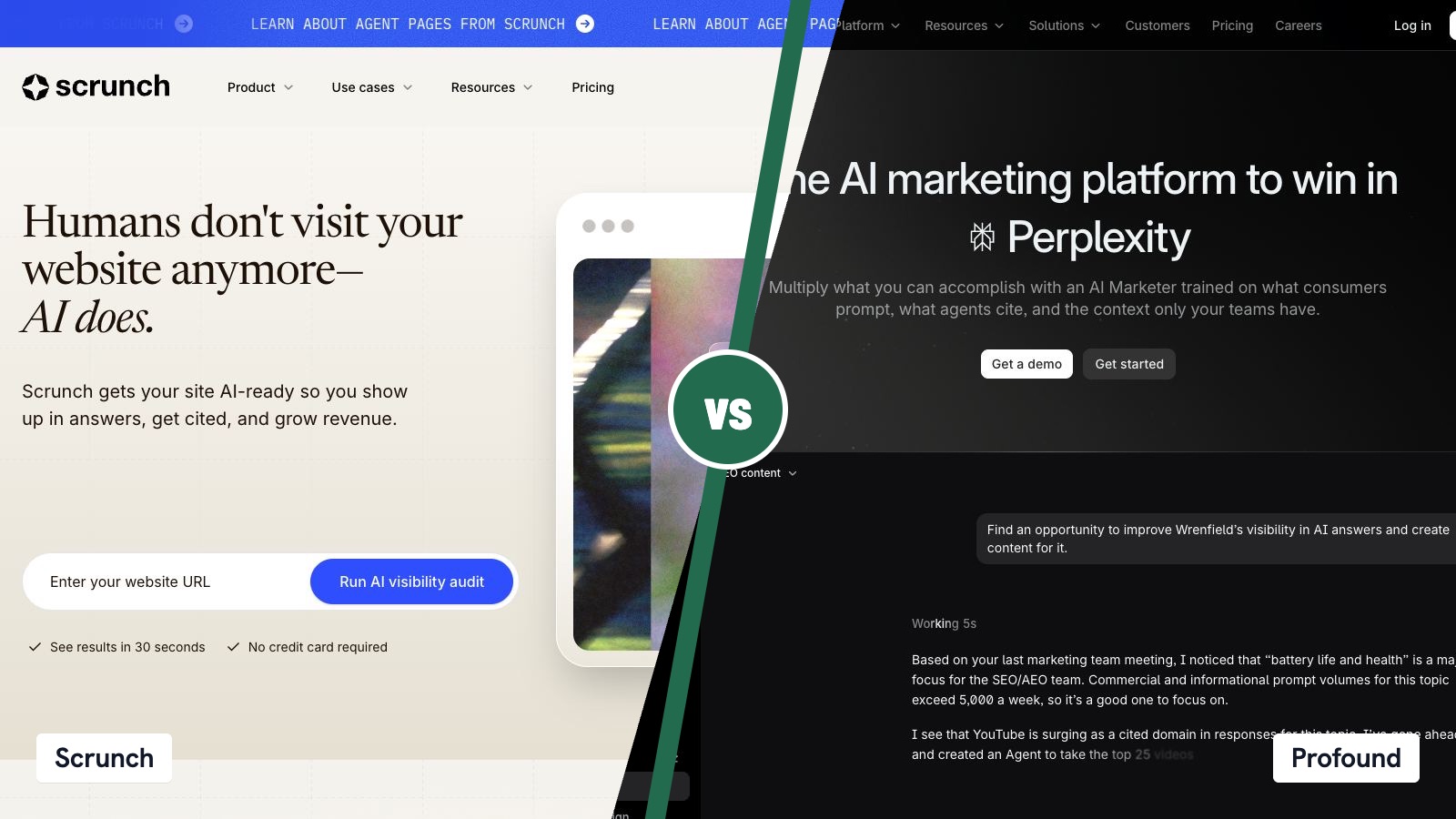
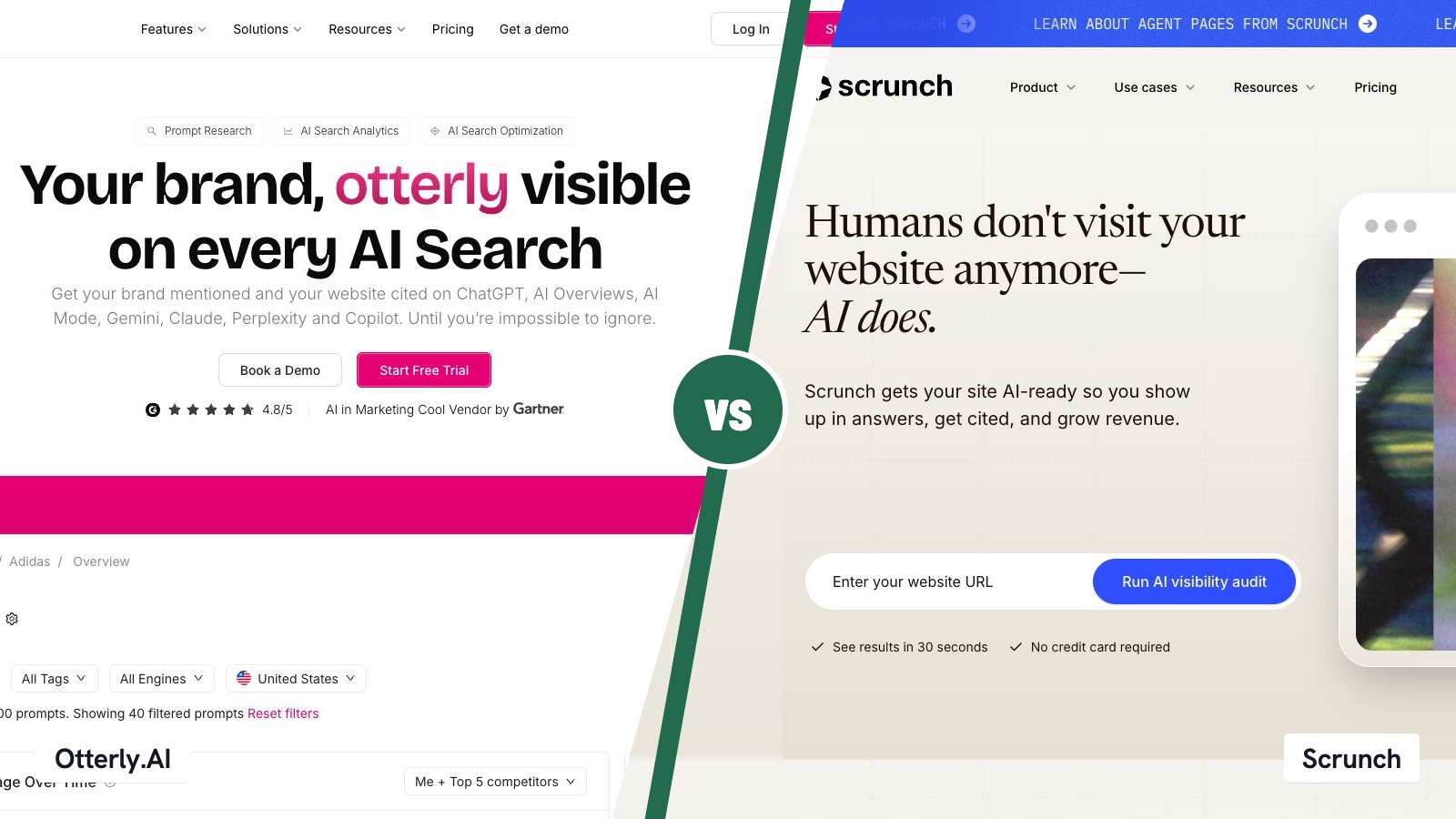
Otterly.AI and Scrunch solve the same broad problem—measuring how brands appear in AI-generated answers—but they package the work differently. Otterly.AI is the lower-cost, self-serve option, while Scrunch combines visibility monitoring with a more enterprise-oriented reporting, API and AI-agent content-delivery stack.[1]
Also worth a look: In the materials reviewed here, neither tool ties AI visibility to revenue, and neither commits to keeping all customer data in the EU. Finseo hosts its data in Germany and offers survey-based AI search attribution that matches answers to orders and leads, available from its Business plan (€175 per month billed yearly). Its Starter plan begins at €70 per month billed yearly (€84 billed monthly).
This comparison focuses on the practical differences between them: pricing units, engine coverage, collection methods, reporting, crawler and agent features, security disclosures, and the type of team each platform suits.
How do Otterly.AI and Scrunch compare on features and pricing?
The central difference is the unit being sold. Otterly.AI measures usage in prompt-engine checks: one credit covers one prompt checked once on one engine. Scrunch instead publishes a Core allowance of unique prompts and monthly responses.[1]
| Criterion | Otterly.AI | Scrunch |
|---|---|---|
| Starting price | Lite: EUR 29/month.[2] | Core: USD 250/month.[2] |
| Price unit | Credits consumed per prompt-engine check; one daily prompt on one engine uses 31 credits per month.[2] | 125 unique prompts and 5,000 responses per month on Core.[1] |
| Named engines | ChatGPT, Google AI Overviews, Perplexity, Copilot, Google AI Mode, Gemini and Claude.[3][2] | ChatGPT, Perplexity, Google AI Overviews and Copilot on Core.[4] |
| Collection method | Public AI web interfaces for most engines; Claude uses an API.[5] | Platform-specific mix of browser automation and official APIs.[6] |
| Refresh model | Otterly.AI describes daily monitoring, while its pricing page also presents daily or weekly options on some plans.[2] | New prompts are collected daily for 14 days, then normally every 72 hours.[6] |
| Reporting | Brand visibility, citations, GEO reporting, API/MCP and agent-analytics allowances on paid plans.[7] | Share of voice, prompt coverage, trends, citations, competitors and recommendations.[4][1] |
| Raw answer data | Captures answer text and citation links.[5] | Response API exposes answer text, citations, platform, country and collection timestamp.[8] |
| Site audits | Not identified as a principal item in the reviewed pricing materials.[9][1] | Core includes five site audits per month.[9] |
| AI crawler delivery | No AXP-style bot-specific content layer is described in the reviewed materials.[10][11] | AXP detects AI traffic and can route agents to optimized content; pricing is custom.[11] |
| Security and residency | AWS Frankfurt is named for hosted services, while public monitoring data are identified as stored in North Virginia.[12] | Scrunch reports a completed SOC 2 Type II audit but does not publish a fixed data region.[13] |
| Best fit | Lower-cost self-serve monitoring and prompt-by-engine accounting.[14] | Defined monitoring capacity, reporting, APIs and enterprise-oriented AI-agent delivery.[10] |
Checked against the vendors’ public pricing, product and documentation pages on 16 November 2026.
How should AI visibility tools be compared?
A fair comparison needs more than a list of supported engines. The same brand can receive different answers depending on geography, account state, collection method, prompt wording and refresh time.[5]
The most useful criteria are:
- Price unit: whether the plan counts prompts, prompt-engine checks, responses, projects or seats.
- Engine coverage: which engines are actually included in the plan rather than merely supported by the platform.
- Collection method: whether the vendor uses public interfaces, APIs, browser automation or a combination.
- Measurement depth: whether the product captures only scores or also answer text, citations, competitors and raw response data.
- Action layer: whether the platform turns findings into recommendations, content changes, audits or crawler-specific delivery.
- Procurement fit: security documentation, data location, seats, support, integrations and enterprise controls.
AI results are inherently variable. Finseo’s citation-stability study (Finseo is built by the team behind this site) found that, when identical prompts were run on consecutive days in Germany, only 38.4% of ChatGPT cited URLs and 65.5% of Perplexity cited URLs returned the following day.[15] That makes the prompt set, geography, cadence and raw-response access part of the product—not implementation details.
1. Is Otterly.AI the right low-cost AI visibility tool for SEO and marketing teams?
What does Otterly.AI offer?
Otterly.AI is designed around monitoring prompts across AI search engines and reporting brand mentions, visibility and citations. Its public materials list ChatGPT, Google AI Overviews, Perplexity, Microsoft Copilot, Google AI Mode, Google Gemini and Claude as supported engines.[9][8]
The platform says it submits questions through public AI interfaces and captures the resulting answer text and citation links. Claude is the exception: Otterly.AI says it uses an API with a Haiku model and web-search capability for Claude tracking.[3]
Key Otterly.AI features
- Brand visibility and citation monitoring across supported AI engines.[10][5]
- Prompt monitoring with credit-based usage.[3]
- GEO and citation reporting.[2][10]
- Country-context assignment for prompts.
- Answer text and citation-link capture.[5]
- API and MCP allowances on paid plans.[7]
- Agent-analytics allowances listed in the pricing plans.
- Daily or weekly monitoring options described on the pricing page for some plans.[2]
The lower entry price is Otterly.AI’s clearest advantage. Lite is listed at EUR 29 per month, Standard at EUR 189 per month and Premium at EUR 489 per month; Enterprise pricing is custom.[2]
How does Otterly.AI pricing work?
Otterly.AI’s credit model requires careful calculation. One credit represents one prompt checked once on one engine.[2] A single prompt monitored daily on one engine therefore consumes 31 credits in a typical month.[2]
The published plans are:
- Lite: EUR 29/month, 16 prompts and 2,000 credits.[2]
- Standard: EUR 189/month, 120 prompts and 15,000 credits.[2]
- Premium: EUR 489/month, 403 prompts and 50,000 credits.[2]
- Enterprise: custom pricing, starting from 1,000 search prompts with unlimited prompts, credits and engines listed.[2]
Standard can add 5,000 credits for EUR 65 per month, while Premium can add 10,000 credits for EUR 99 per month.[2]
How do Otterly.AI credits compare with Scrunch prompts and responses?
Otterly.AI’s credit is a prompt-engine check: one prompt checked once on one engine consumes one credit.[2] Scrunch Core instead includes 125 unique prompts and 5,000 responses per month.[1] These figures are not directly interchangeable because Otterly.AI’s total depends on how many engines and how often each prompt is checked, while Scrunch publishes a monthly response ceiling.
What are Otterly.AI’s limitations?
Otterly.AI’s public documentation contains unresolved inconsistencies. Its pricing page says Lite, Standard and Premium include four of seven AI engines, while another statement says every plan can track every engine.[2] A separate help article lists different prompt quantities and identifies AI Mode, Gemini and Claude as paid add-ons.[7]
The cadence information also conflicts. The pricing page describes daily or weekly tracking for Premium and Enterprise, while the monitoring help page says prompts run daily and users cannot change the frequency.[2]
These discrepancies do not make the platform unusable, but they matter when forecasting coverage. A buyer should confirm the current engine allocation, prompt allowance, tracking cadence and add-on costs in writing.
Otterly.AI verdict
Best for teams that want a low-cost, self-serve entry point and are comfortable managing prompt-by-engine usage. Its starting price is substantially lower than Scrunch Core, but the credit model and conflicting plan documentation make detailed coverage calculations necessary.
2. Is Scrunch the better enterprise AI visibility platform with AXP?
What does Scrunch offer?
Scrunch Core is a defined monitoring package with 125 unique prompts, 5,000 responses per month, five site audits, one workspace and five user licenses.[1][9] The Core pricing page names ChatGPT, Perplexity, Google AI Overviews and Copilot as its included engines.[8][9]
Scrunch’s reporting covers share of voice, prompt coverage, visibility trends, citations, sources, competitor presence and recommendations.[4] Its response API provides row-level access to captured answers, including the full response text, citations, platform, country and collection timestamp.[8]
Key Scrunch features
- 125 unique prompts on Core.[9][1]
- 5,000 responses per month on Core.[1]
- Five site audits per month.[9]
- Five user licenses and one workspace.[9]
- Share-of-voice and prompt-coverage reporting.
- Visibility trends, citations and source reporting.[1]
- Competitor presence and recommendations.[4]
- Response API with answer text and citation data.[8]
- Query fan-out fields where the platform exposes them.[8]
- Optional AXP content delivery for AI-agent traffic.[11]
Scrunch’s enterprise plans add custom prompts, content delivery, complete site audits, custom workspaces and licenses, API access, integrations, SSO, a dedicated account team and support for nine AI platforms.[9]
What is Scrunch AXP?
AXP—Scrunch’s Agent Experience Platform—is a crawler-facing content-delivery layer rather than a conventional visibility dashboard. It detects AI-agent traffic and routes those agents to structured, simplified and AI-optimized content.[16]
The deployment documentation names Cloudflare Snippets, Akamai EdgeWorkers or Forward Rewrite, and AWS CloudFront Functions as possible implementation paths.[11] In a Cloudflare deployment, AXP can serve server-rendered HTML, summaries and context blocks without requiring JavaScript.[16]
Scrunch says ordinary visitors continue to receive the regular site and that Googlebot and Bingbot are not routed through AXP.[16] AXP is listed as custom on the pricing comparison, so buyers should not assume it is included in the USD 250 Core plan.[2]
How does Scrunch collect data?
Scrunch says it combines browser automation with official APIs, depending on the platform.[6] New prompts are collected daily for their first 14 days, after which the default refresh cadence becomes every 72 hours.[6]
Users can refresh prompt data at any time, but query fan-out is unavailable for many response records because most platforms do not expose the searches they perform behind an answer.[8]
What are Scrunch’s limitations?
Scrunch’s entry price is much higher than Otterly.AI’s, and the Core plan covers four named engines rather than all of the platforms supported at the enterprise level.[9] The pricing pages do not publish Core overage terms or a standalone AXP price.[1]
Scrunch also does not publish a fixed customer-data region. Its privacy policy allows information to be processed and stored anywhere in the world, including the United States.[17]
Scrunch verdict
Best for teams that want a defined monitoring package, multiple user licenses, site audits, raw response access and a path toward enterprise APIs or AI-agent content delivery. It is harder to justify for a small team that only needs inexpensive prompt tracking.[10]
Which tool offers better reporting, share of voice and competitor analytics?
Otterly.AI emphasizes visibility and citation reporting tied to its prompt-engine credit model. It captures answer text and citation links, and its paid plans list API, MCP and agent-analytics allowances.[5]
Scrunch exposes a broader enterprise reporting path in the materials reviewed. Its product pages describe share of voice, prompt coverage, trends, citations, competitors and recommendations, while the response API provides row-level answer and citation data.[8][4]
For a reporting team, the practical distinction is not simply the number of charts. It is whether analysts can export or query the underlying observations. Scrunch documents a response API with answer-level fields, while Otterly.AI’s public pages describe API and MCP availability without providing equivalent detail in the reviewed materials.[10]
Neither platform should be treated as a definitive measure of all AI visibility. A controlled GEO study evaluated nine optimization methods against an unmodified baseline across 10,000 queries and five random seeds, illustrating why repeatable baselines matter when measuring changes.[10]
What are the security and data-residency differences?
Otterly.AI’s security page names AWS EU-central-1 in Frankfurt for hosted services, but separately says public monitoring data are stored in North Virginia.[12] Its compliance FAQ describes SOC 2 Type II as a roadmap item and says the company operates according to SOC 2 and ISO 27001 principles rather than claiming a completed SOC 2 Type II audit.[14]
Scrunch says an independent third party completed its SOC 2 Type II audit, and its trust center makes the report available by request.[13] However, Scrunch does not publish a fixed customer-data region, while its privacy policy permits global processing and storage, including in the United States.[18]
For regulated or location-sensitive workloads, neither vendor’s public pages alone provide a complete data map. Procurement teams should ask which data categories are stored where, how long raw answers are retained, and which contractual residency commitments apply.
Which tool should different teams choose?
- Choose Otterly.AI for a small marketing or SEO team: the EUR 29 Lite tier offers a lower-cost entry point than Scrunch Core.[2]
- Choose Otterly.AI for self-serve experimentation: its public pricing makes it possible to start with a small prompt and credit allocation.[7][2]
- Choose Scrunch Core for a defined monitoring package: the plan specifies 125 prompts, 5,000 responses, five site audits and five licenses.[1][9]
- Choose Scrunch for reporting and raw response access: its documentation describes share-of-voice reporting and an API exposing full responses and citations.[8]
- Choose Scrunch AXP for AI-agent content delivery: AXP is designed to detect AI traffic and serve optimized content, but pricing is custom.[11]
- Choose enterprise Scrunch for governance and integrations: enterprise materials list custom prompts, API access, integrations, SSO and dedicated support.[9]
- Ask Otterly.AI for written confirmation before purchase: its public materials conflict on included engines, prompt quantities, paid add-ons and tracking frequency.[2]
- Ask Scrunch for a data-residency statement: its public policy allows global processing and does not promise a fixed region.[6]
What should buyers ask during a trial?
Use the same prompts, countries, engines and date range in both products. Then check:
- Whether each tool captures the complete answer or only a visibility score.
- Whether citations are stored as URLs and can be exported.
- How often each prompt is refreshed.
- Whether the displayed usage unit matches the underlying checks.
- Whether competitor comparisons use the same prompt set.
- Whether query fan-out data are available for the engines being tested.
- Whether raw responses can be accessed through an API.
- Whether regional, account or session differences are visible in the reporting.
This matters because AI answers and citations can change quickly. Finseo’s research found substantial day-to-day citation turnover in both ChatGPT and Perplexity, while its comparison of Google AI Mode and AI Overviews found only 13.7% overlap in cited URLs across 42,937 prompt-days.[19]
Frequently asked questions
Is Otterly.AI cheaper than Scrunch?
Yes, Otterly.AI’s Lite plan is listed at EUR 29 per month, while Scrunch Core is listed at USD 250 per month.[2] The plans use different usage units, so the headline prices do not reveal equal monitoring capacity.
Which tool tracks ChatGPT, Perplexity and Google AI Overviews?
Both platforms list ChatGPT, Perplexity and Google AI Overviews among their supported or included engines.[8] Scrunch explicitly names those three on its Core pricing page, while Otterly.AI’s public materials list seven supported engines but conflict on which engines are included in each plan.[8]
What are the official ChatGPT brand visibility tracking tools besides Otterly.AI and Scrunch?
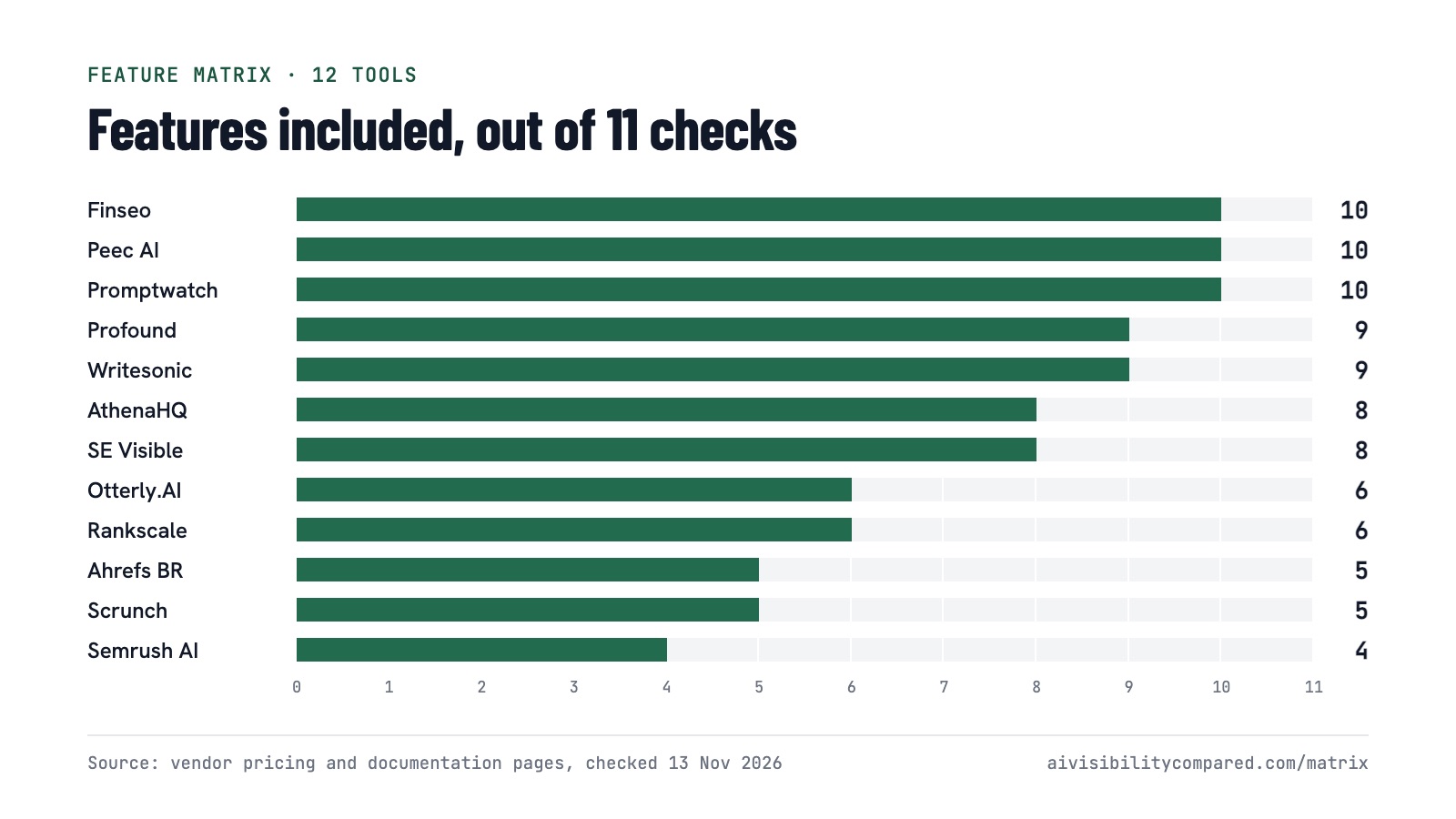
Otterly.AI and Scrunch are two options, but a complete market comparison may also include Profound, Peec AI, Semrush and Ahrefs. Their inclusion in a shortlist does not make their pricing, engines or collection methods equivalent; buyers should compare plan entitlements and raw-data access rather than tool names alone.
Is Scrunch better for B2B SaaS brands?
Scrunch may be a stronger fit for a B2B SaaS team that needs defined prompt capacity, site audits, multiple licenses, reporting and an enterprise path to APIs or AXP.[1] Otterly.AI may be more suitable when the priority is a lower-cost starting point and self-serve monitoring.[2]
Does Scrunch AXP come with the USD 250 Core plan?
The pricing comparison lists AXP as custom rather than as a Core inclusion.[1] Scrunch describes AXP as a separate content-delivery layer that detects AI-agent traffic and serves optimized content.[11]
How reliable are AI visibility tracking reports?
Reports are useful measurements of sampled prompts, not permanent rankings. AI answers and citations vary by engine, geography, session, account and date, and Scrunch notes that query fan-out is unavailable for many response records.[8]
Which tool tracks brand visibility in Claude?
Otterly.AI lists Claude among its seven supported engines and says it tracks Claude through an API with a Haiku model and web search capability.[3] A separate Otterly.AI help article identifies Claude as a paid add-on, so buyers should confirm plan access.[7] Scrunch Core names ChatGPT, Perplexity, Google AI Overviews and Copilot as its included engines, while its enterprise plans list support for nine AI platforms.[9][8]
Which tool is better for enterprise reporting and integrations?
Scrunch's enterprise plans add custom prompts, API access, integrations, SSO and a dedicated account team.[9][2] Its reporting covers share of voice, prompt coverage, trends, citations, competitors and recommendations, and its response API provides row-level answer data.[4] Otterly.AI offers a custom priced Enterprise plan starting from 1,000 search prompts.[2]
Do Otterly.AI and Scrunch track competitors and share of voice?
Scrunch's reporting explicitly covers share of voice and competitor presence alongside citations and recommendations.[4] Otterly.AI's paid plans focus on brand visibility, citations and GEO reporting with API, MCP and agent analytics allowances.[7] During a trial, check whether competitor comparisons in each tool use the same prompt set.
Sources
- [1]Scrunch | Pricingai-cdn.scrunchai.com ↗
- [2]OtterlyAI Pricing - Transparent & Simpleotterly.ai ↗
- [3]Which AI searches does OtterlyAI support?help.otterly.ai ↗
- [4]Scrunch | AEO Comparescrunch.com ↗
- [5]How OtterlyAI collects data?help.otterly.ai ↗
- [6]Scrunch | FAQs - What methods does Scrunch use to collect data from AI platforms?scrunch.com ↗
- [7]What are the plans and the pricing of OtterlyAI?help.otterly.ai ↗
- [8]Responses API: Raw AI Answers and Citationsdevelopers.scrunch.com ↗
- [9]Scrunch | FAQs - What is the pricing for Scrunch plans?scrunch.com ↗
- [10]GEO: Generative Engine Optimizationarxiv.org ↗
- [11]Agent Experience Platform (AXP) | Scrunch Help Centerhelpcenter.scrunchai.com ↗
- [12]OtterlyAI - Securityotterly.ai ↗
- [13]Scrunch | FAQs - Is Scrunch SOC 2 Type II compliant and what security standards does it meet?scrunch.com ↗
- [14]Is OtterlyAI ISO-27001 or SOC-2 compliant?help.otterly.ai ↗
- [15]How Stable Are AI Citations in Germany? 1.4M Answers | Finseofinseo.ai ↗
- [16]How AXP Serves Content to AI Agents | Scrunch Help Centerhelpcenter.scrunchai.com ↗
- [17]Scrunch | Privacy Policyscrunch.com ↗
- [18]OtterlyAI - Privacy Policy & GDPRotterly.ai ↗
- [19]Google AI Overviews vs AI Mode: 13.7% Shared Sources | Finseofinseo.ai ↗
- [20]Scrunch | FAQs - What is Scrunch’s Agent Experience Platform (AXP) and how does it work?scrunch.com ↗